A Site on the Edge of Town
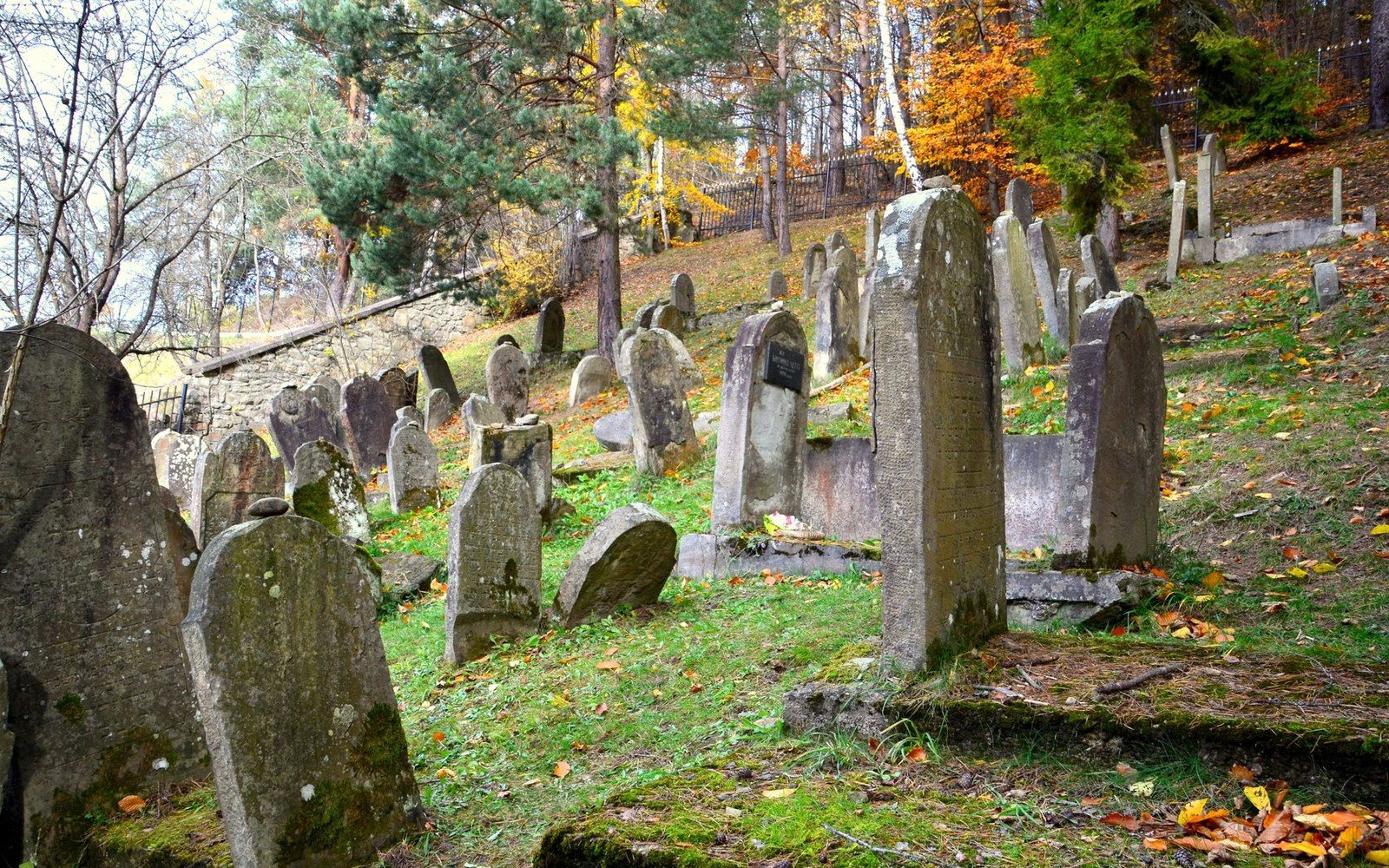
The site remains in use as a cemetery space — meaning it has not been built over — though the enclosure, the condition of individual stones, and the ground cover have all changed substantially since the interwar period. What survives is a partial field of matzevot (singular: matsevah), the upright carved stone markers that constitute both the primary funerary monuments of Ashkenazic Jewish communities and, in aggregate, a dense documentary record in carved stone.
The cemetery is documented in the holdings of Yad Vashem as part of its community record for Zabłudów, and cross-referenced in YIVO Institute for Jewish Research materials alongside the photographic archive that is now among the most-consulted records of the town's pre-war built environment. Neither source offers a comprehensive stone-by-stone inventory; what they supply is confirmation of the site's existence and its broad spatial relationship to the town plan.
What the Stones Record
A matsevah is an architectural object before it is anything else. It is shaped — typically from local limestone or sandstone — to a defined typology: a rectangular stele, sometimes with a semicircular or gabled head, occasionally with a carved relief in a framed panel above the inscription field. The relief vocabulary of Polish-Jewish matzevot is largely consistent across the region: a pair of hands for a priestly Cohen family, a pitcher for a Levite, a menorah, a crown, an animal symbol keyed to the deceased's given name. These are not decorative choices made at the mason's discretion; they are coded identifiers that place the individual within a communal taxonomy.
The inscription below the relief is typically in Hebrew and follows a formulaic structure — the opening blessing, the name of the deceased with the father's name in the patronymic construction, the date of death in the Hebrew calendar, and the closing blessing. Where dates can be cross-referenced with civil records held by the Polish State Archives in Białystok, the stones become primary sources for demographic and genealogical reconstruction, and for understanding the pace at which the community expanded or contracted across generations.
Carving quality varies by period and by the wealth of the commissioning family. Eighteenth-century stones at sites across Podlaskie tend toward bold, schematic relief work in which the chisel leaves visible facets; later nineteenth-century stones often show finer modelling and sometimes incorporate decorative borders drawn from Central European ornamental pattern books. The Zabłudów stones that remain legible display this range, though no complete typological survey of the site has been published in accessible form.
Material Evidence in Place
The physical condition of matzevot at any Polish Jewish cemetery depends on stone type, ground drainage, the degree of disturbance during and after the Second World War, and maintenance since. At Zabłudów, as at comparable sites documented by the Foundation for Documentation of Jewish Cemeteries in Poland, tilting, sinkage, and surface spalling are the routine decay modes. A stone that has settled out of vertical sheds rainwater across its face rather than away from it, accelerating legibility loss.
The cemetery at Zabłudów has not undergone the kind of systematic photographic and epigraphic documentation that some larger sites have received. This is not unusual in Podlaskie, where the density of surviving Jewish burial grounds is high and the resources available for formal survey are limited. What the stones offer — as objects, as inscribed surfaces, as evidence of a mason's hand and a community's visual conventions — remains largely unread at the level of detail that a measured architectural survey would supply. In that respect, the cemetery shares its condition with the wooden synagogue that once stood a short distance away: substantially documented by absence, and waiting for the kind of attention that records what is there before it is gone.