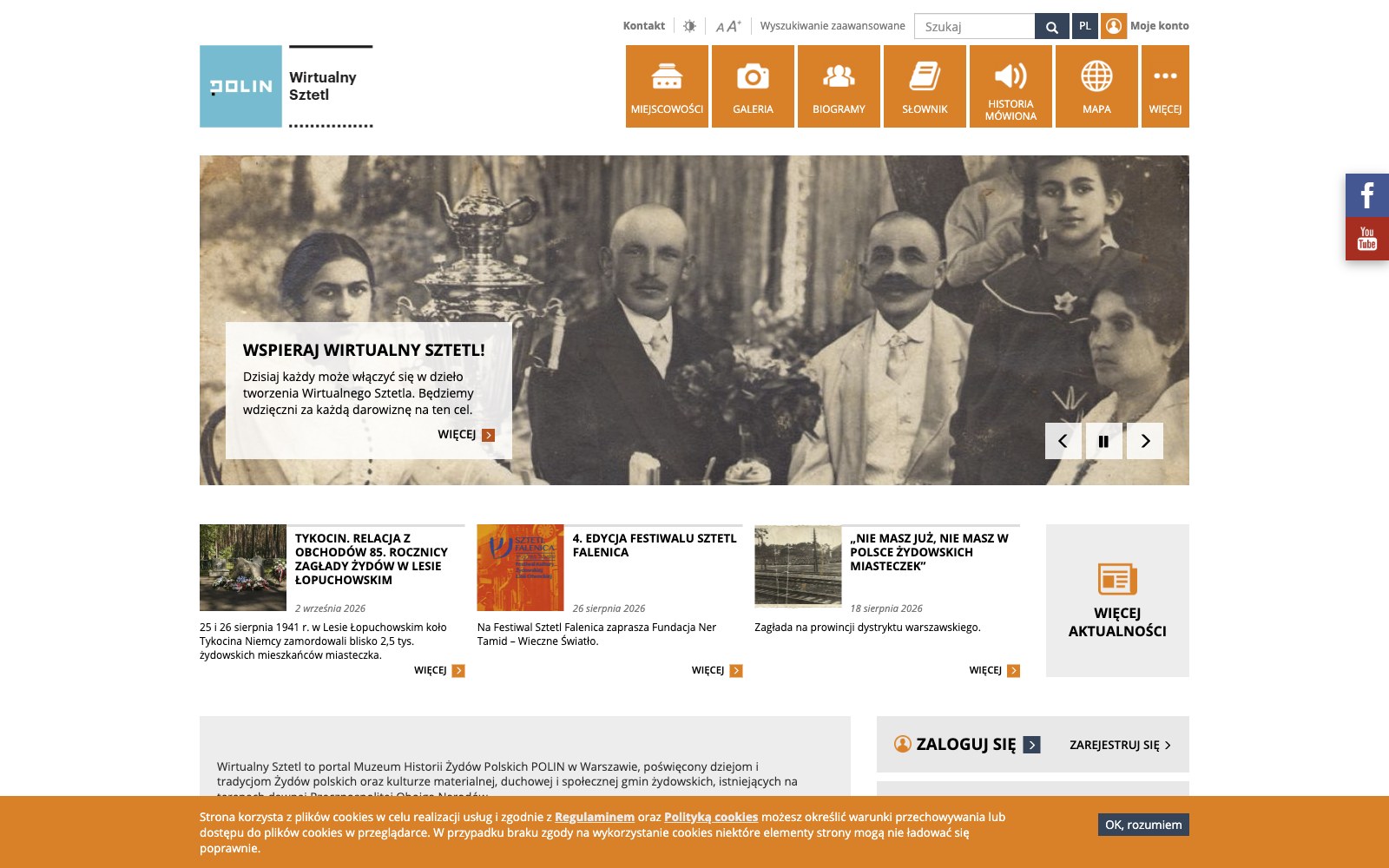

Two databases, one subject, different contents
Its primary function is encyclopaedic rather than archival: for each town that held a Jewish community before the Second World War, the platform assembles a structured entry covering community history, notable individuals, institutions, and surviving physical traces. The Zabłudów entry documents the town's pre-war Jewish population, its religious buildings, and the community's destruction in 1941–1942 — stated as a dated fact, not narrated. The platform does not hold original documents; it indexes and summarises information drawn from published scholarship, memorial books (yizkor bikher in Yiddish), and institutional records held elsewhere.
Jewish Records Indexing — Poland, known as JRI-Poland, operates a separate database with a different character entirely. Where Virtual Shtetl is descriptive, JRI-Poland is a finding aid: it indexes vital records — births, marriages, deaths — extracted from registers held in Polish state archives and in collections abroad, linking each entry to the archive and shelf mark where the original document sits. For Zabłudów, the indexed records derive from registers now held at the Polish State Archives in Białystok, the institution that holds the town's pre-war civil and religious documentation.

The distinction matters to researchers in a specific way. Virtual Shtetl tells you what existed; JRI-Poland tells you where a specific record can be located. Neither is a substitute for the primary source, and neither provides copies of original documents through its own interface. Both are reference layers over physical collections that sit in named institutions and require consultation through those institutions' own access procedures.
For the Zabłudów synagogue specifically, neither database carries architectural or survey material. The measured drawings produced by Warsaw University of Technology fieldwork in the 1920s are held in drawing archives, not in vital-records collections, and fall outside the scope of both platforms. Photographs, drawn surveys, and building documentation are held in separate repositories — YIVO among them — and must be traced through those collections independently. What Virtual Shtetl and JRI-Poland together provide is a mapped entry point into the documentary world of a community whose physical presence, including the synagogue, no longer exists at its original site.