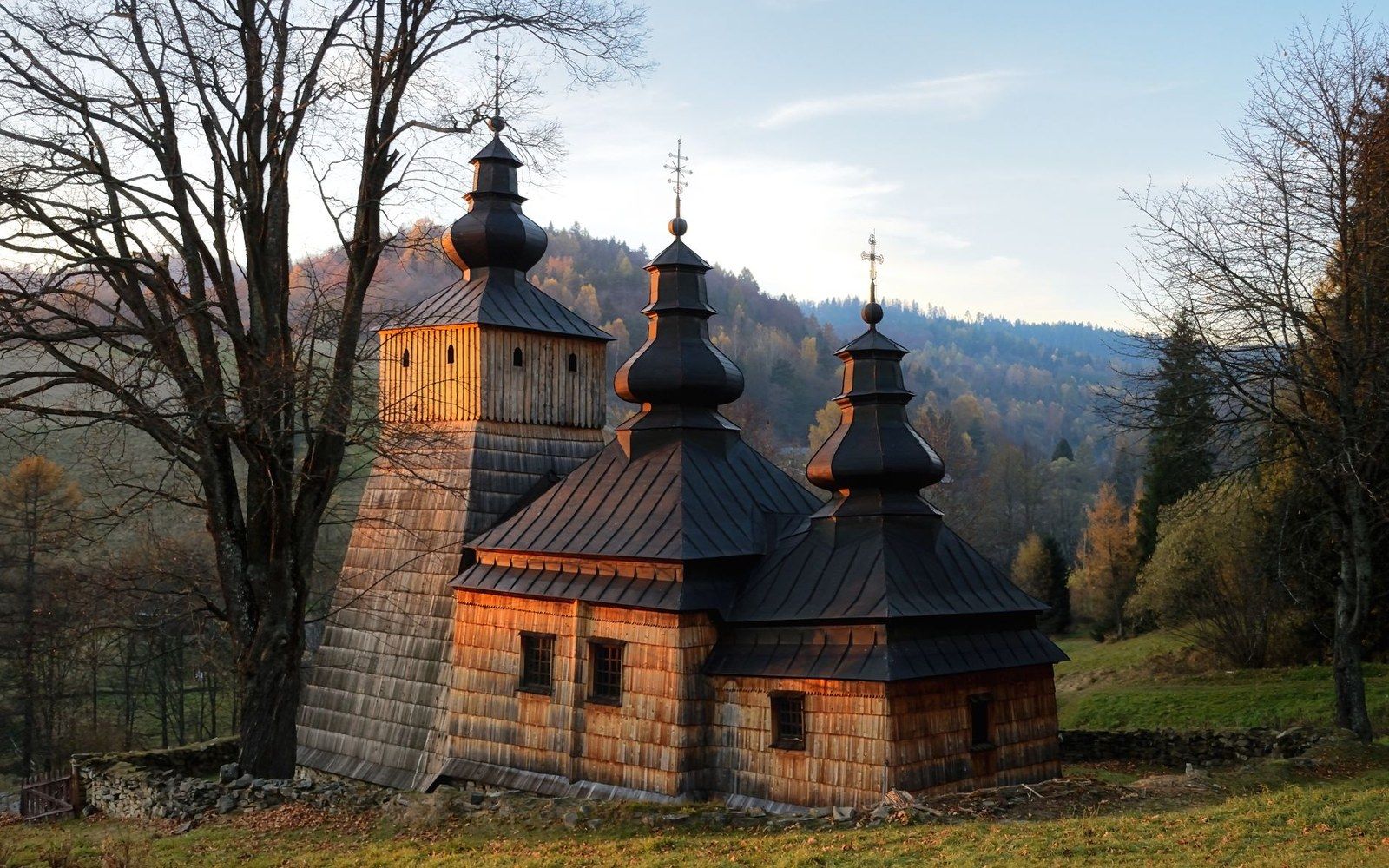

What the Inscription Covers
The Wooden Tserkvas of the Carpathian Region entered the UNESCO World Heritage List in 2013 as a transboundary serial property, with Poland and Ukraine as co-nominating states. Sixteen individual sites make up the inscription: eight stand in southeastern Poland, eight in western Ukraine. The Polish sites are distributed across the Małopolska and Podkarpacie regions, in terrain where the Carpathian foothills press the settlements into narrow river valleys. The Ukrainian sites lie along the same mountain arc, across what was, before the twentieth century's border revisions, a continuous cultural and ecclesiastical zone.
A tserkva is a timber Orthodox or Greek Catholic church of the Carpathian region, distinguished by tiered log construction and domed or helmet-shaped roofing. The word is used in both Polish and Ukrainian heritage literature; the spelling follows the original languages in the UNESCO documentation. What the sixteen sites share is not a single plan type but a structural logic: horizontally laid logs locked at each corner by interlocking notch cuts, walls rising through successive diminishing tiers, each tier capped by a polygonal or circular drum and a dome clad in shingles split from local softwood. The vertical silhouette — low nave, taller crossing, tallest tower — reads as a landscape marker from a considerable distance. Inside, the proportional relationship between the tiers is felt as well as measured: the nave ceiling rises through the drum into painted vaulting, and the spatial sequence differs markedly from the Latin-rite churches built in the same districts during the same centuries.
The inscription distinguishes three regional subtypes within the Carpathian tserkva tradition: the Lemko type, the Boyko type, and the Hutsul type, each associated with a distinct ethnic and confessional community of the Carpathian highlands. The Polish eight include representatives of the Lemko type, characterised by a strongly horizontal roofline and a western tower integrated into the nave block, and of the Boyko type, which tends toward taller, more clearly separated domed bays. The Ukrainian eight carry examples of all three subtypes. UNESCO's advisory body, ICOMOS, confirmed that taken together the sixteen sites demonstrate the outstanding universal value of the tradition more completely than any single building could.
Construction and What It Shares with the Neighbouring Tradition
The structural system at the core of every tserkva on the list — notched-corner log construction — is the same system used in the timber synagogues of Podlaskie and in the vernacular domestic and agricultural buildings of both regions. Logs are selected, hewn or adzed to a consistent face width, laid in courses, and locked at each corner without nails or a separate structural frame. The corner joint carries the wall's lateral stability; the wall carries the roof load. What differs between a tserkva and a Podlaskie granary is the complexity of the roof geometry above: the tserkva builder was solving a problem of three-dimensional curved surfaces in a material that works best in straight horizontal courses, and the shingle cladding — overlapping pieces split rather than sawn from the block — was the technology that made curved domes legible on the outside while the interior framing resolved the geometry in timber.
This shared constructional grammar matters for heritage researchers working across the Carpathian and Podlaskie traditions simultaneously. The hand tools, the joinery vocabulary, the maintenance cycles for shingle replacement, the vulnerability to sill rot at the base of each wall: these are held in common. The wall construction and joinery are the same; the differences lie mainly in roof geometry and framing above the walls, and in form and liturgy.
What the Inscription Does Not Cover
The 2013 inscription is specific and bounded. It does not extend to the much larger body of unlisted Carpathian timber churches still in use or in varying states of repair across both countries, and it carries no automatic protection for those structures. Each of the sixteen sites is subject to the heritage legislation of its own state. The inscription documents a tradition; it does not conserve one. That distinction, familiar to anyone working with the timber vernacular of Podlaskie's largely unprotected building stock, is worth holding clearly in view.