Remains of the Bialystok Great Synagogue

MY VISIT TO BIALYSTOK IN 1977

by

IZAAK RYBAL-RYBALOWSKI

(from the Bialystok Memorial Book, New york, 1982)


In1945, returning to Bialystok after the war, I was horrified how thorough Hitler's destruction of our hometown was. It was incredible that such devastation could be visited upon our city during the war years. Most of what we cherished had disappeared.

In December 1977, when I revisited Bialystok after 32 years, it had changed entirely. Jewish Bialystok has been replaced by a modern metropolis.

I returned to Poland as a delegate of the Federation of Polish Jews in America, together with other distinguished colleagues. Our mission, representing Polish Jews all over the world, was to negotiate several important issues with ministers of the Warsaw government. Our committee included Rabbi Dr. Alexander Schindler, Chairman; Shlorno Ben-Israel and Eli Zborowski, Vice-Chairmen; Ben Gray, Los Angeles; Jechiel M. Dobekirer, Secretary; Kalman Sultanik; and myself as Treasurer.

 In Warsaw we met with officials of Polish Government ministries. We insisted on free access to Jewish archives and documents in Poland; the release to Jewish communities all over the world of religious articles used in worship that remain in Poland; the erection of monuments at the mass graves of Jewish victims of the Nazis scattered in the Polish earth without appropriate markers; a Jewish museum depicting the horrors and Jewish heroism at the Auschwitz-Birkenau concentration camp, to be founded with the guidance of Jewish experts in the field; and the payment of disability benefits and pensions to Polish Jews who were required to renounce their citizenship before being allowed to leave Poland after the war.

In addition to Warsaw, our delegation went to Lublin and Krakow. Visiting the concentration camps at Auschwitz, Majdanek and Treblinka, where millions of our Jewish brethren were liquidated, was painful. Particularly heartrending were some 800 large and small stones, at the site of the gas chambers in Treblinka, inscribed with the names of destroyed Jewish communities in Poland. The 800 stones signify, as indicated on a sign when one enters the camp, 800,000 Jews killed there. I found a big rock upon which the name Bialystok was etched. My eyes brimmed with tears, and I uttered a silent prayer.

To be sure, I reserved time to visit Bialystok as soon as I knew I would travel to Poland. Tuesday, December 13, 1977 was free. Dr. Szymon Datner, who lives in Warsaw, knew in advance about my plans and was prepared to accompany me to Bialystok. We left Warsaw Tuesday morning in a taxi. Little did I realize that a bitter experience awaited me later that day.

The ride took 2½ hours. The trip seemed endless. The signs along the road reminded me of towns and villages familiar to all Bialystoker landsleit. For in those places, Jews had lived their culture to their heart’s content until the "Final Solution" buried them. Today not even a hint can be found of what once was.

As we know, prewar Bialystok counted some 90,000 inhabitants, among them approximately 60,000 Jews. Contemporary Bialystok sprawls in all directions; its population numbers more than 200,000. Sadly, the Jewish contingent has shrunk to nine people. Living in different parts of the city, they have little to do with each other. I asked them why they remained in this unfamiliar, rebuilt, modern city that was once our beloved hometown. Their answer was that the war left them isolated, broken and sick. It was difficult for them to travel about looking for other places to live. It was easier to remain in Bialystok. Their names are: Szyja Bartnowski, Abram Sidranski, L.M. Penner, Lejba Bielski, Erszel Jalowski, Kalman Kania, Jankel Chaszkes, Szloma Pachter, and Szymon Zlotorynski.

The Bialystoker Center in New York is in touch with these people, and several times a year we send them money orders. Jerry Mink, our Center’s devoted supporter, established a fund for the remaining Jews in Bialystok, shortly after he returned from a visit there several years ago.

When Dr. Datner and I arrived in Bialystok, Szyja Bartnowski guided us to sites where memorable buildings and other places of interest used to be. We were saddened that the three Jewish cemeteries in Bialystok are neglected. The Bagnowke Cemetery was desecrated, monuments either gone or vandalized. Houses were built on its grounds. The old cemetery on Minski street has been shut down; a pedestrian walkway crisscrosses it to the center of town. The Zabia Cemetery within the Bialystok ghetto was converted into a park. Thirty-five hundred graves were disturbed, the remains exhumed and reburied together in an obscure corner of the area. A monument draws attention in Polish to this fact. Szyja Bartnowski promised me he would take care of this monument. I looked around, hoping against hope that something familiar would appear, that my alienation would subside. I became increasingly depressed as I wandered through the city.

I looked for particular Jewish houses, factories, organizations and institutions, newspapers, theaters, schools, sports clubs, trade unions and any other evidence that there once was an organized, well-developed Jewish community. Some reminders do exist.

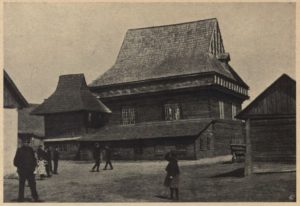
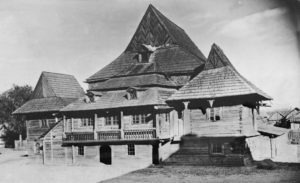
 Bialystoker landsleit remember the Great Synagogue where the Nazis burned 2,000 Jewish men, women and children on Friday, June 27, 1941. After the war, Jews who returned to Bialystok collected remnants of the synagogue. I discovered that even this modest attempt to memorialize the destruction failed. On the site of the singed iron remains of the shul stand modern houses. If you look carefully, you can find an inconspicuous inscription stating that there was once a synagogue there. Similarly, Cytron’s Bet Hamidrash no longer exists as such; the building is intact but it now houses the Polish Center of Culture and Art.

The Hebrew Gymnasium, that remarkable institution where hundreds of boys and girls received a fine Jewish education, has been replaced by a hospital. Dr. Datner, who accompanied me on the visit, had taught there for more than 25 years. Seeing what happened to his beloved school, he sobbed uncontrollably. His display of emotion overwhelmed me.

 I left Bialystok heartbroken. After Dr. Datner and I said goodbye to Szyja Bartnowski, we rode away in our taxi, turning around for a last glimpse of the town where we spent our youth and where so many of our beloved relatives perished.

In our subsequent talks with the Polish Government, we emphasized the disgraceful condition of Jewish cemeteries. The ministers assured us that they would restore many of these burial places and, upon my insistence, they promised to rehabilitate Bagnowke Cemetery in Bialystok.

Jewish Bialystok no longer exists in Poland. Rather, it survives in the form of our great Bialystoker Center in New York, which perpetuates its hallowed traditions. It is our obligation to uphold its ideals, heritage and aspirations in America and other countries where Bialystokers live. Let us pledge to fulfill this sacred responsibility that our martyred families passed on to us.

Web: 2003 Tilford Bartman